Dual Flow Batch Auctions
Westren Capital · 22 July 2026 · 15 min read
Convergence on the Continuous Limit Order Book (CLOB) design pattern occurs due to the efficiency of the CLOB design in a centralized infrastructure setting where buyers and sellers meet via a common order book, prices move continuously due to information updates and liquidity providers compete with each other via price-time priority mechanism. Over the course of decades, this approach proved to be successful in the context of equities, futures and foreign exchange where deterministic matching engines, synchronized clocks and managed infrastructure reduce execution uncertainties.
Implementation of the identical architecture on a blockchain platform, however, implies a completely different paradigm. The ordering of transactions in a decentralized fashion becomes a part of consensus algorithm rather than an implementation detail of the exchange. Ordering of transactions, their propagation and inclusion in a block affects execution results. Therefore, the matching engine gets inherited inefficiency from beyond the system, producing economic effects unrelated to price discovery or liquidity provision.
It means that participants become more competitive in terms of gaining execution priority, rather than in the correctness of their prices. In this case, liquidity providers put many efforts into updating or cancelling their quotes before the news becomes available on the market, whereas latency-driven traders strive to execute against these quotes before they get cancelled. Any move in the external prices triggers a battle between the cancellation of a quote and its aggressive execution. The profits from this battle are not gained due to increased market efficiency. They transfer from one participant to another depending on the speed of response.
Public blockchains contribute to the problem even further since pending transactions become visible prior to their execution, block producers have some degree of discretion with regards to the ordering of transactions, and the determinate visibility of order flow enables frontrunning, sandwiching, and other kinds of Maximal Extractable Value (MEV). These practices lead to increased spreads, reduced liquidity, and greater execution costs for the exchange participants.
The core issue here is not the blockchain’s capacity, execution time, and computational power. The key issue here is the fact that continuous matching creates dependency of execution on the order in which transactions take place. Better hardware, shorter blocks or greater capacity will decrease friction but will not change the fundamental incentives generated by the matching system.
A better way forward is to look at the matching system rather than continue improving the system’s implementation.
What we do at Westren Capital is we have a market design that replaces continuous matching with batch execution, and separates liquidity providers from liquidity consumers prior to matching. Rather than having each new incoming order interact with the order book right away, orders are collected during an auction period and then executed simultaneously at the same clearing price. Maker liquidity competes only for taker liquidity.
In this way, the difference completely shifts incentives in the market. In a conventional CLOB, there is competition among liquidity providers along three different axes: accuracy of pricing, inventory and speed of execution. The last axis has meaning solely due to the fact that continuous matching incentivizes early arrival. With DFBA, execution priority is removed from the auction process, shifting competition back into economically productive axes like tight spread, large quoted size and accurate valuation.
But the advantages go further than simply mitigating the risks of latency arbitrage. Adverse selection costs faced by the liquidity providers become lower as quotes will not be constantly exposed to all outside price updates. Natural flow participants get fairer execution thanks to uniform price clearing versus transaction order dependent clearing. Quality of market is improved since the participants compete in providing better liquidity.
Design of decentralized exchanges has steadily advanced in addressing these structural problems, albeit each generation tackling only some of them.
Instead of evolving based on a specific design philosophy, decentralized exchanges have continuously evolved to improve different dimensions of market quality. Each succeeding architecture has optimized only one part of the trading process without addressing other inefficiencies that exist within its structure.
Earlier architectures mainly focused on liquidity access by allowing a permissionless entry into the exchange at the expense of efficiency of capital. Subsequent architectures have instead concentrated on execution quality, reducing slippage and improving price discovery through active liquidity provisioning. Recent architectures have concentrated on order flow protection, reducing information leakage, execution-order dependence and any value extraction through different auction or private execution processes. However, there is no current architecture that optimizes for liquidity efficiency, execution fairness, inventory risk management and protection from toxic order flow.
What all architectures lack in common is the fact that nearly all decentralized markets are still optimized around continuous interactions between liquidity providers and liquidity takers. While the execution is either done via an automated market maker (AMM), order book, request-for-quote (RFQ) network or auction, the liquidity providers are still exposed to informed order flow right before the execution takes place.
In terms of market microstructure, therefore, the main issue is not matching or settlement latencies, but rather the way in which information should be integrated into prices without unduly rewarding those that can capitalize on this information through execution timing. With the maturation of decentralized markets, the goal moves away from optimizing throughput and towards reducing structural information asymmetries between liquidity providers and liquidity consumers.
In spite of tremendous progress in the technology of decentralized exchange, there is one economic axiom that continues to hold true: liquidity providers still provide continuously executable quotes against an uncertain distribution of informed and uninformed order flow. Decreased latencies for sequencing, settlement, and execution simply make the process more efficient but do not solve the underlying problem of adverse selection. Higher execution speeds do not remove toxic order flow; they just compress its occurrence time frame. From a market structure standpoint, the bottleneck lies not in matching speed but in quote optionality. Each quote left on the books gives the other party the choice but not the obligation to execute when new information makes it economical to do so. Hence rational market makers must take into account not only implied volatility and inventory risk, but the likelihood that the quote becomes stale even before it can be revised. This is reflected in higher spreads and shallower quote books.
In contrast to such inefficiencies, the Dual Flow Batch Auction solves the problem of inefficiencies through a change in the economics of providing liquidity rather than the technology behind it. By executing orders only during defined clearing periods, and dividing the relationship between market makers and takers into two stages before matching, the DFBA eliminates the continuous optionality feature inherent to resting liquidity. The competitive dynamics move from execution time preference to price accuracy and liquidity commitment, allowing market makers to compete based on valuation rather than speed.
Mechanics of Dual Flow Batch Auction
So auction periods start by receiving all available buy and sell orders within the auction period along with any carryover liquidity from past auction clearing periods. As opposed to forming one aggregate order book, the dual flow batch auction splits the liquidity pool into two different economic categories: makers and takers. This distinction is critical because the DFBA ensures that makers do not compete directly with each other but only compete with executable demand.
Two separate clearing mechanisms are performed at the same time: the bid auction clears maker buy liquidity against taker sell demand, while the ask auction clears maker sell liquidity against taker buy demand. Because both auctions are solved simultaneously, no execution bias is introduced by either side, and bid and ask liquidity develop independently based on supply and demand balance.
In each individual auction, the clearing algorithm computes the executable price which would result in maximum matched volume consistent with limit price and price monotonicity constraints of the participants. Orders which have been priced more aggressively relative to the clearing price are afforded execution priority. Allocation of residual volume on the margin level is based on proportional distribution of display volume between identical priced participants and thus eliminates any arbitrary queue priority advantage of the latter.
Uniform price settlement results in the case where all successful participants in an auction are settled at one single price irrespective of the order in which their orders were placed. Thus, in contrast to execution quality in continuous markets, where similar quotations might lead to significantly different outcomes purely due to timing, DFBA removes this form of execution asymmetry.
Unfilled liquidity is carried forward in future auctions and remains subject to the pricing constraints in which it was initially offered. In DFBA this allows liquidity providers to maintain their market presence without having to re-quote their liquidity interest again and again. Quote management in such markets is thus naturally event driven as opposed to continuous markets.
In each case, this would mean that the auction itself is a completely separate instance of price discovery where liquidity suppliers are competing not on speed of infrastructure but on valuation, depth, and capital commitment. The fundamental difference here is that DFBA separates the competition to form a price from the competition to execute.
Example: Dual Flow Batch Auction with 150 ms Auction Interval
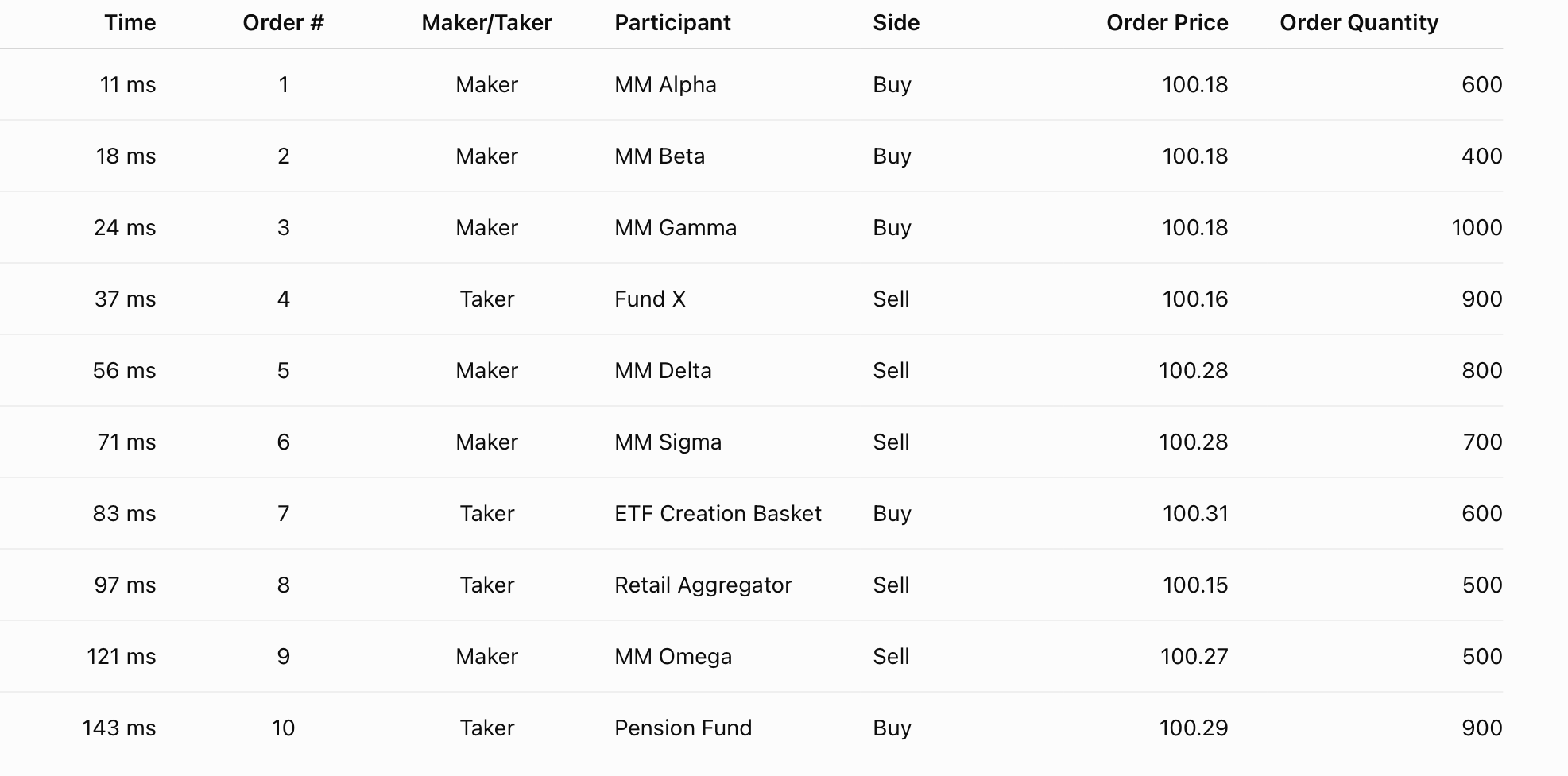
Suppose the following orders are submitted during a 150 ms auction interval. Three independent market makers quote identical prices, while natural-flow traders submit marketable liquidity-taking orders throughout the auction.
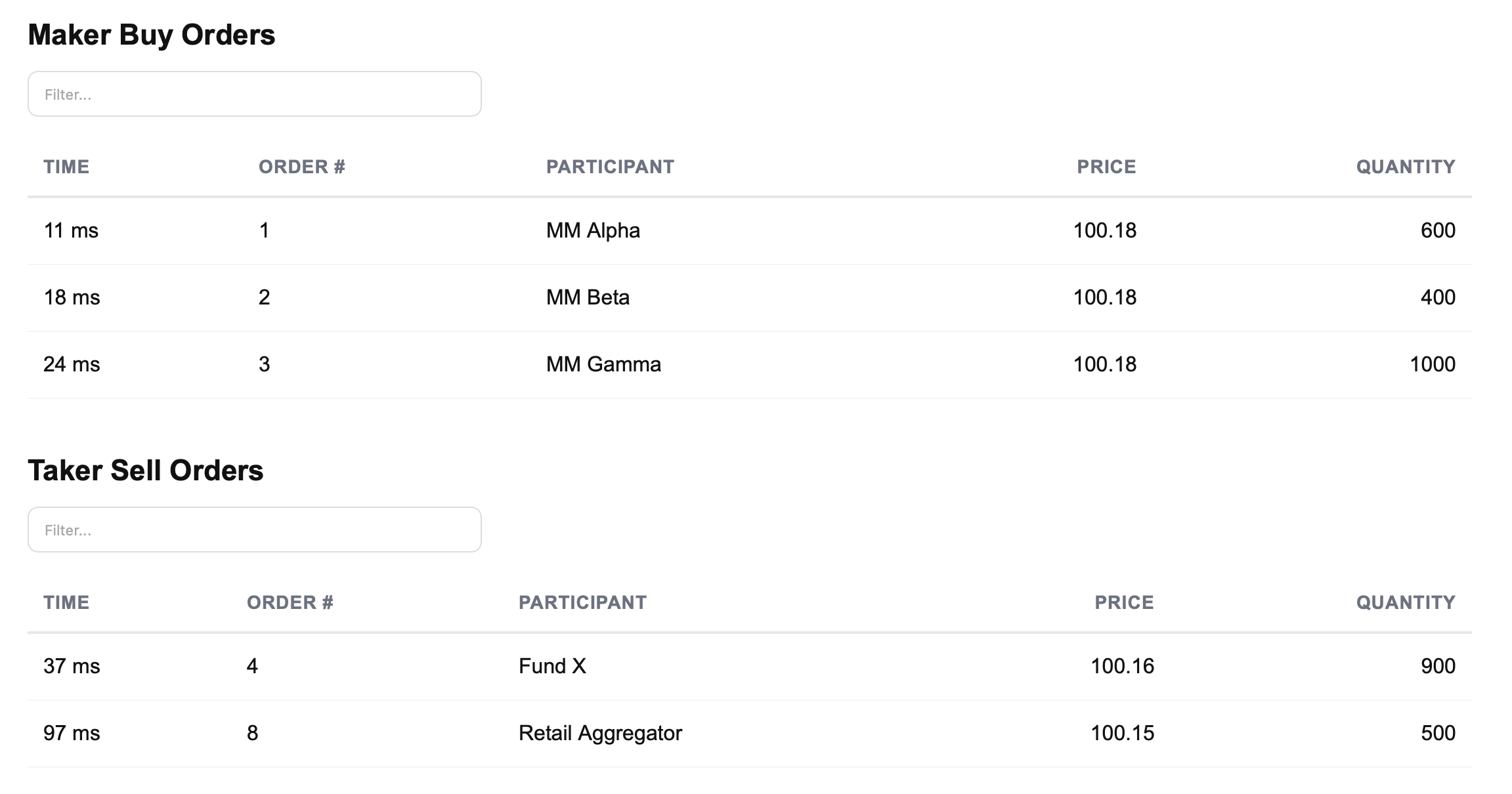
Bid Auction
(Maker Buys vs Taker Sells)
Bid Auction Clearing
A clearing price of 100.18 maximizes executable volume.
Total executable sell quantity = 1,400
Total executable maker demand = 2,000
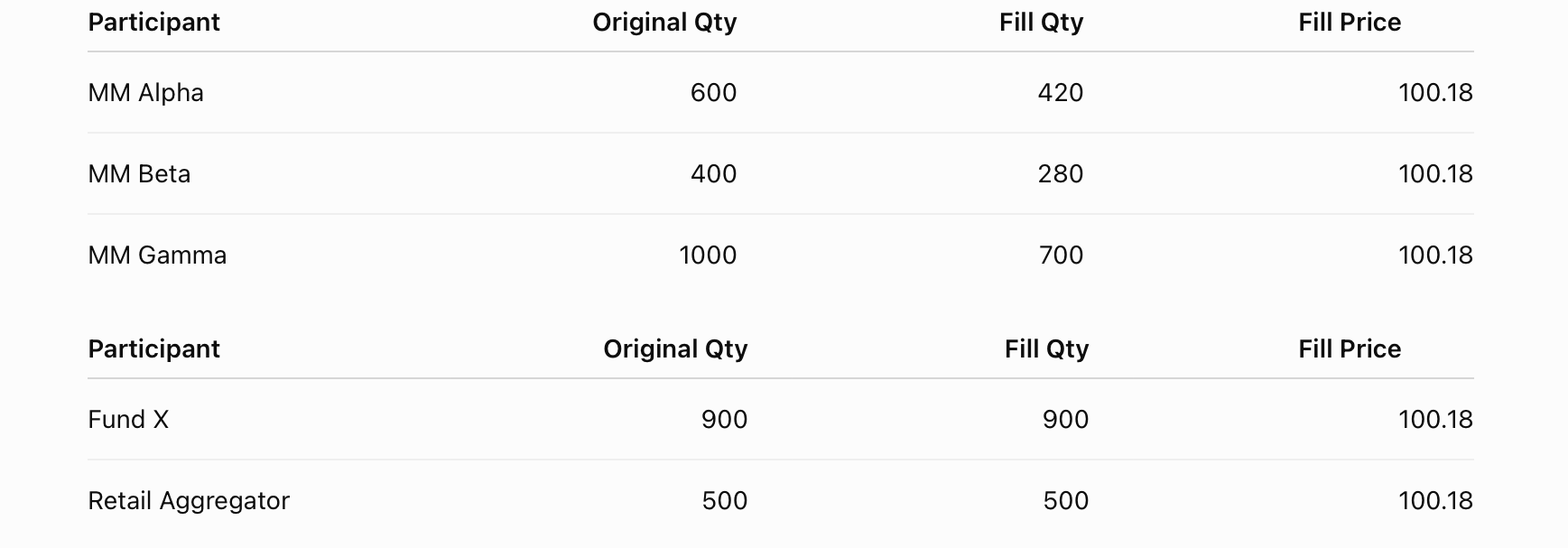
Since all three market makers quoted exactly the same price, allocation is performed pro-rata rather than according to arrival time.
Bid Auction Fills
Ask Auction
(Maker Sells vs Taker Buys)
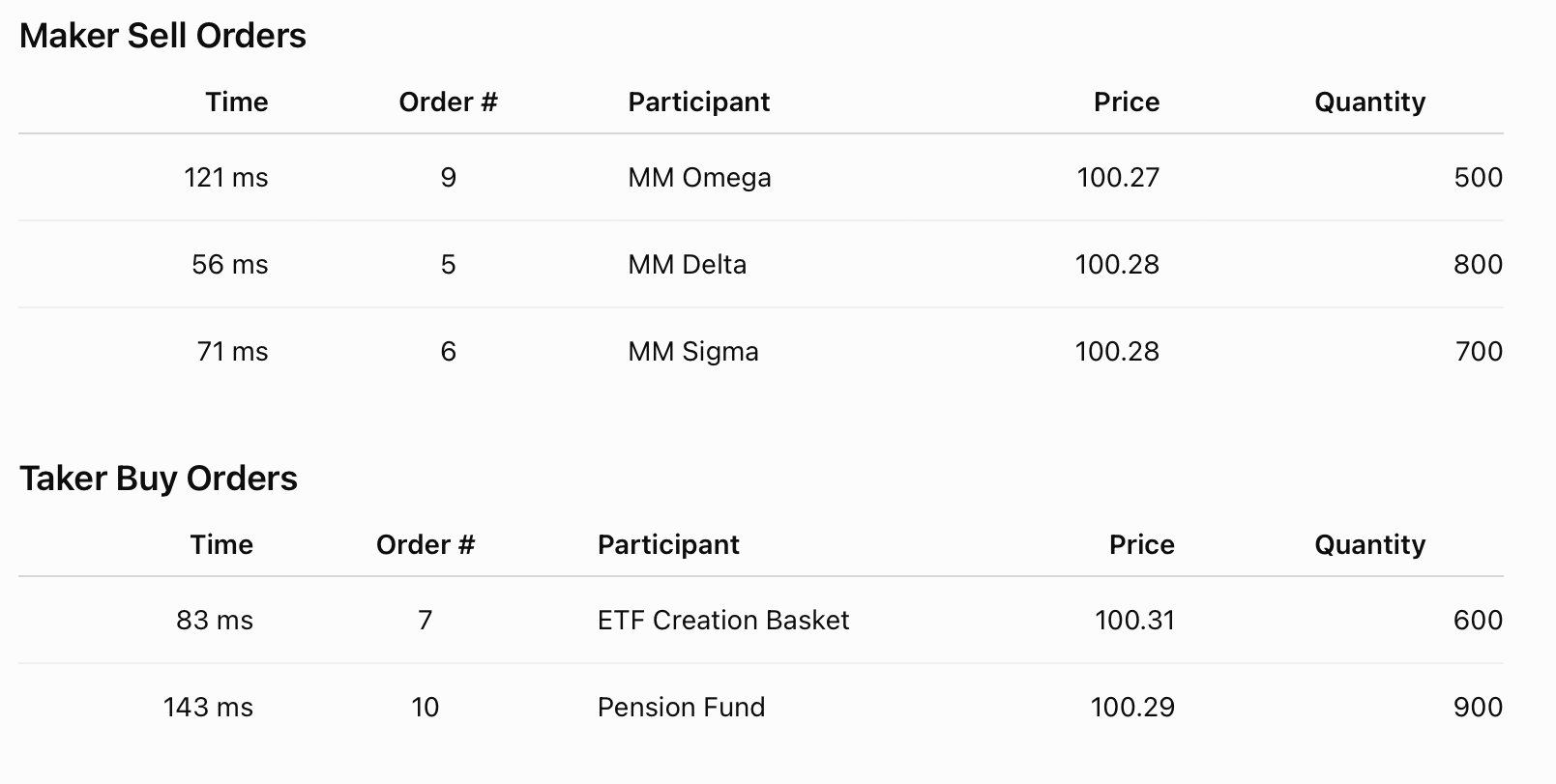
Ask Auction Clearing
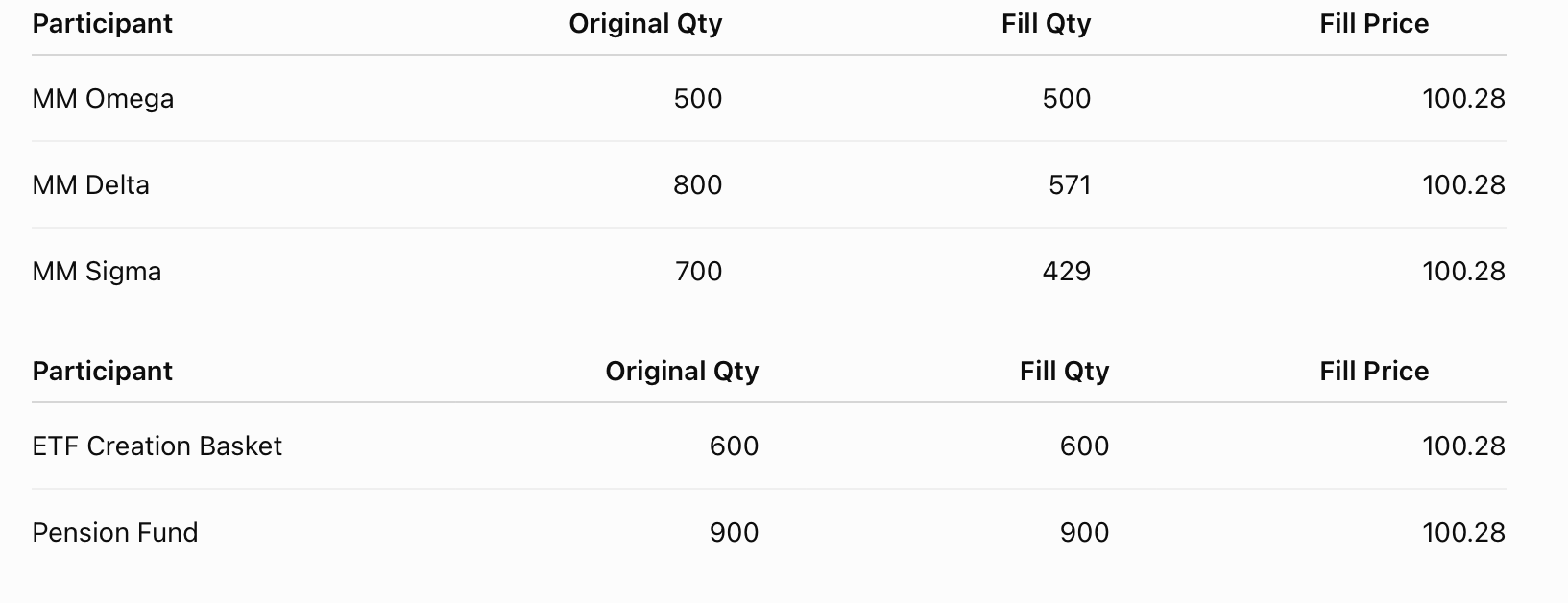
A clearing price of 100.28 maximizes executable volume.
Total executable buy quantity = 1,500
Total executable maker supply = 2,000
Orders priced below the clearing price receive execution priority first. Remaining liquidity at 100.28 is allocated pro-rataamong participants quoting the same price.
Ask Auction Fills
Orders Remaining for the Next Auction
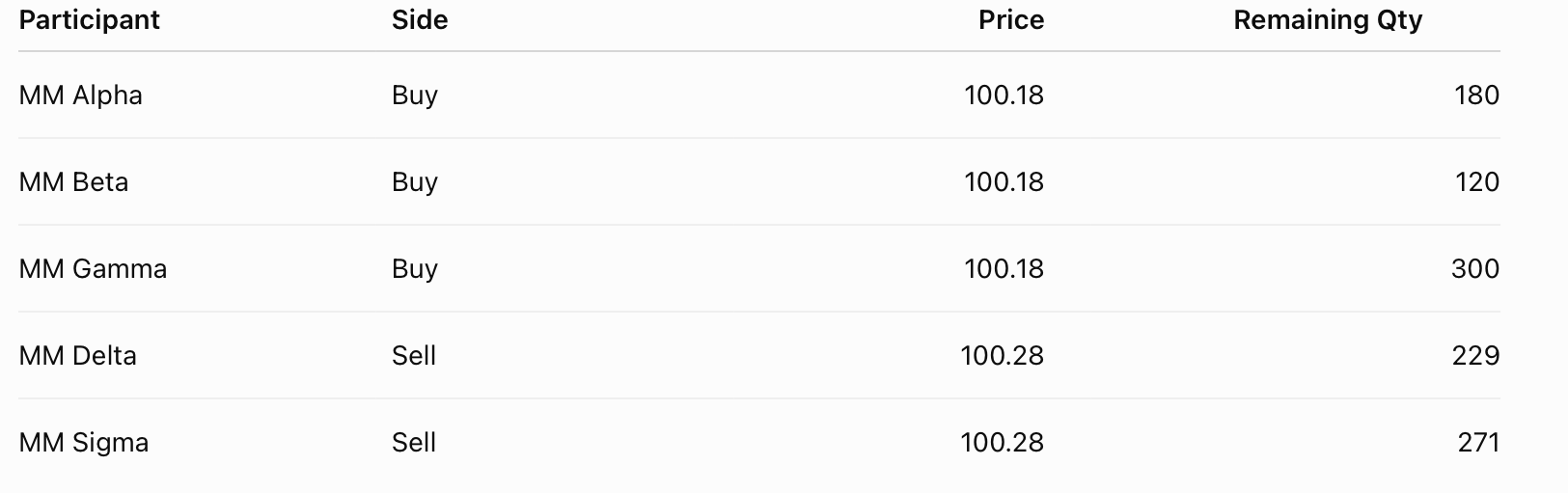
This example shows an important difference between a Dual Flow Batch Auction and a standard Continuous Limit Order Book, where multiple liquidity providers provide the same bid price but the executions are resolved in a collective resolution process and not by placement or time of submission. In other words, liquidity providers compete by pricing and quote size but not by managing orders via latency.
The natural flow participants get a single execution price based on the natural flow order sequence, while the liquidity providers get their executions proportionally based on the clearing marginal price. This auction is able to maximize executable volume and at the same time preserve price discovery without providing an advantage in economic terms to continuous racing for better queue priority.
In terms of market microstructure, the competition is shifted by the auction from the execution timing to pricing efficiency, making the market characterized by higher levels of liquidity provision, order modification and deterministic economically neutral clearing process with regard to participant latency.
Why Auction-Based Matching?
Continuous matching is based on the premise that the market should instantly respond to every new order and any new information. As such, this creates maximum immediacy but also makes execution priority an economic good. Thus, competition in the market includes not just price competition but more and more the ability to revise, cancel and submit new orders before competing liquidity seekers are able to act.
Every change in the external price level causes the market makers to experience an adverse selection risk. Orders that used to be competitively priced will no longer be, giving informed traders an opportunity to trade against the illiquid liquidity before revisions are made. Thus, huge investments in infrastructure do not improve market quality; instead, they determine who gets the same economic rents.
These costs end up being passed along to the natural flow traders. The rational market makers will offset their expected adverse selection risks by making wider bid-ask spreads and smaller sizes. Therefore, there is no reduction in the economic cost of liquidity provision due to improvements in speed of execution.
Decentralized markets exacerbate this phenomenon. The sequencing of transactions, propagation times and block construction become elements of the execution process, giving rise to ordering affecting economic consequences. Hence, competition will increasingly center around attaining positive execution priority rather than enhancing the effectiveness of the price mechanism. It generates additional opportunities for value extraction with no contribution towards efficient price discovery.
Batch auctions solve this incentive problem by making execution discrete. The orders compete in a joint clearing period rather than competing continuously over time, thereby greatly diminishing the economic benefits of acting marginally faster than other competitors. Pricing becomes a question of supply and demand in the batch rather than of the order of message arrival.
The Case for Dual Auctions
Apart from being a form of refinement of batch auctions by decoupling making and taking flows into separate clearing procedures, DFBA is an additional refinement of batch auctions. While traditional batch auctions involve the competition of liquidity providers for queue positions and trade priority at the same time, DFBA separates these competitions: liquidity providers compete only for executable liquidity provided for natural-flow participants.
Bid and Ask Auctions are two independent auctions that separate buying pressure from selling pressure and maintain transparent price discovery on each of their sides. Thus, liquidity providers compete only with liquidity providers based on price and size, while takers compete only based on their trading willingness. The separation prevents unneeded competition among market makers and focuses competition on what matters for execution.
Microstructure-wise, the design moves competition efforts from latency-related behavior to economically meaningful goals.
Maker & Taker Identification Approach
DFBA does not require any specific technique for maker and taker flow identification. Rather, the participant classification should depend on the properties of the particular exchange and its participants.
Examples of possible classification approaches are:
Designated Market Makers – approved liquidity providers always offer two-sided markets and only trade in the capacity of maker flow, as typical for most institutional/wholesale exchanges.
Behavioral Classification – classification of market participants on the basis of historical behavior, inventory turnover, order persistence and toxicity indicators as liquidity provider and consumer respectively.
User Designated Intent – explicit designation of maker and taker orders by users, where makers focus on better execution possibilities and price improvement and takers on faster execution. Proper fee structures could easily promote such classification without any participation restrictions.
In contrast to Continuous Limit Order Book, where maker and taker roles are determined based only on order arrival time, in DFBA the participation mode is defined by user intention and role in the market.
Batch Interval Selection
A common criticism of batch auctions is that they introduce latency by delaying execution until the next clearing event. This assumes that lower latency always improves market quality. In reality, beyond a certain threshold, reducing execution latency provides rapidly diminishing benefits to natural-flow participants while significantly increasing the incentives for latency-sensitive competition.
Continuous markets transform every microsecond of latency reduction into an economic advantage. Market makers continuously update quotes while informed traders attempt to execute before those updates occur. The resulting infrastructure race consumes substantial engineering and capital resources without materially improving execution quality for the participants the market is intended to serve.
Empirical observations from highly liquid markets suggest that short auction intervals capture nearly all meaningful price information while eliminating most latency-driven competition. For actively traded products, batch intervals between 100 ms and 500 ms preserve near-continuous price discovery while materially reducing stale-quote exposure, order churn and transaction-order dependence. From a user experience perspective, execution within this range remains effectively instantaneous while fundamentally altering the incentives governing market participation.
The goal thus should not be reducing latency at any cost, but rather picking the appropriate auction frequency that will ensure maximum order execution quality by taking into consideration market structure and not just infrastructure.
Liquidity Competition over Latency Competition
The true innovation of the Dual Flow Batch Auction does not lie in switching from a continuous matching model to a periodic one, but in altering the competitive dynamics of participants.
In other words, instead of giving priority to the participants who execute their trades faster than others, the DFBA gives priority to the participants who quote accurately, have good liquidity, and make real capital commitments. Liquidity providers can no longer get an inherent benefit out of being marginally faster than the competition, while natural-flow participants trade against a market in which liquidity is driven by value, not queue position.
Among the many benefits of such an approach, there are:
- The change in competition from latency to price efficiency.
- Lower risk of adverse selection allows for narrower spreads and deeper liquidity.
- Uniform-price settlement offers a more equitable execution process for both sides of the market.
- More persistent quotes, less unnecessary order adjustment.
- Exchange volumes reflect economic activity more than latency-induced trading.
At the end the Dual Flow Batch Auction provides an alternative to current decentralized market microstructures in which latency is used as the principal parameter defining the quality of the trade execution. In contrast, the model re-engineers the relationship between liquidity providers and liquidity consumers so that both parties have aligned incentives in price discovery and liquidity distribution.
Through dividing the roles of makers and takers into separate flows and executing the trades through regular auctions, the model overcomes most of the inefficiencies inherent in continuous matching, while maintaining competitiveness of the market and deterministic execution.
Although the implementation specifics might vary among different exchanges, the general economic principle is applicable widely in situations when clear price formation, robust liquidity provisioning, and efficient execution are needed.
Here at Westren Capital, we consider that the development of the next generation market infrastructure lies in improving the alignment of incentives between exchanges, liquidity providers, and natural flow of participants. The Dual Flow Batch Auction could represent one potential solution towards this goal, and we hope this article helps in advancing the discussion of the topic.